pdf version
Deutsch:

Stephen Louis Keeling
June 21, 2026
| DOI: 10.5281/zenodo.20686142 |
pdf version Deutsch: |
|
How free am I, really? Stephen Louis Keeling June 21, 2026 |
|
Summary: On the trace of true freedom I tell of a journey here which is fraught with unknowns. Only at the end of this work do I recognize the evocative word that runs like a thread through it: odyssey. Does a satisfying destination even exist on the horizon? How might a beacon of hope be discernible? The perspective is that of a mathematician, devoted to a lifelong search for a resolution of the contradictory viewpoints which Jung elucidates in CW11, §391 with regard to the Ego-Self relationship. The search ends with a clarity explained here incrementally in developmental steps. I can tell the details with certainty because I am the person on the journey. So I must write in the first person. The resolution of the mystery is subtle, but for me, it is deeply moving and powerful. By the end I feel unquestionably free, in fact, creative. The desire to believe has given way to certainty. Keywords: freedom, creativity, synchronicity, brain-hemispheres, Gödel-Theorem |
| Motivation |
|
Maybe you too have been faced with a relentless mystery which has followed you all your life. Expecting no resolution in this lifetime, we may sometimes hope to be granted the answer to one single question in the afterlife. Many have told me about their questions. My personal mystery is formulated perfectly by Jung's (CW11:391, [18]), where he considers, "How free am I, really?" Everyone who has ever discussed this with me seriously has agreed that the irreconcilable facts would forever remain just that: irreconcilable. I am writing this article now to tell of a resolution which I never expected to be revealed to me. Yes, it is subtle, but it is enough for even this mathematician to feel unquestionably free. Let me start by summarizing (CW11:391, [18]). Jung begins by observing that the Ego emerges from the supraordinate Self and emphasizes: I do not create myself, rather I happen to myself! He recognizes the fundamental importance of this humble insight for the psychology of religious phenomena. Nevertheless, he believes that this insight cannot be complete, since a predetermined dependence of the Ego on the Self would be a meaningless farce. He argues that the Ego must possess its own autonomy. Otherwise, it would never have had to emerge from an already complete unconscious. He reckons with the empirical knowledge that, no matter how much the Ego may be shown to be constrained by chains of cause and effect, it cannot be convinced that it has no freedom. Jung concludes by accepting the summarized facts, as they are, and yet acknowledging that they constitute a contradiction. Can it be that the emphasis on freedom of the Ego in relation to the Self in the previous paragraph overshadows a deeper question? The Self is described as a pre-existing preconfiguration of the Ego, but how free is the Self, really? Einstein not only asserted that God does not play dice, but also questioned whether God had any choice at all when creating the universe [15]. There is a debate in [31] (p. 142) between M.-L. von Franz and a theologian on precisely this point. Her answer is direct, and I read it passionately, hoping it would give me further hints about my urgent questions. But it did not - not then. Up to that time, and until recently, I could see only the two possibilities posed by the modern physical paradigm: lawfulness or lawlessness, e.g., the lawful determinism of the heavens (in the large) or the lawless randomness of the quanta (in the small). The dichotomy seemed undeniable, no matter what substance may be considered, be it material or mental. The concept of time is enigmatic but fundamental for this line of inquiry. What happens in the next moment should either be uniquely determined by the Now or else not. Either the substance flows along a single road, or else there are forks in the road where the flow may jump one way or another for no cause. After the fact, the flow may seem to have been naturally on one way, with no extra-natural influence from an Ego or even a Self. |
| Wake-up Call |
|
From my present perspective, this worldview depicts a dead universe, or worse, an eternal slavery. Without recognizing its archetypal influence on my consciousness, I have gone the way of mathematician and natural scientist. Eventually there came a reaction from my unconscious through the following dream. It surfaced on the 64th anniversary, to the day, of the passing of Wolfgang Pauli, a significant number for him, the number of hexagrams of the I Ching [32]. These circumstances came to my attention later through self-experience during my education at the CGJIZ (C.G. Jung Institute Zurich). Only now can I grasp the broad meaning of the dream: a revolt erupting against the reigning rationalistic chauvinism of our modern collective. Dream: A man has done a woman some terrible harm, to her and to her daughters. She presents the most complete image of a woman ever to appear in any of my dreams. There were no names given in the dream, but here call Her Sophia. She is accompanied by three male cohorts who are each a hybrid of human and animal. Here call them Satyrs. With them She decides to avenge the harm done to Her by doing likewise to the man. Here call Him the Father. He is bound in place by a Satyr, and the Father is thus forced to watch as three of His Sons - a three-fold Sonship - are beaten brutally, each alive and wrapped completely in a linen cloth. Sophia is beating one Son, and two other Sons are being beaten similarly, right and left from Her, by the other two Satyrs. To Sophia's left is yet another Son of the Father, who has a barbaric appearance. Here call him Satan. He wields a pickaxe to beat holes in the ground at regular intervals, as if to make entry points for space below. Suddenly Satan strikes a place where milk begins to pour out of the ground. He is intoxicated by the effusion and drinks the milk with his hands. But the milk has been poisoned by Sophia with Satan's own semen, so He falls to the ground. Although I have only been an observer up to now, I become lucid in the dream, because I can't stand its extreme nature anymore. So I step out of the dream altogether and wake up. It's understandable how this dream evokes unsettling feelings. I share it openly with the hope of giving voice to what seems like a collective affect. I am thankful for the underlying pressure, which apparently has driven the journey I want to tell about here. The resolution of the mystery cannot have been direct, or else it would have been recognized with the terms already considered. The threshold of proof of real freedom must be subtle. I'm drawn to the analogy of the Space Odyssey film [20], in which an unnatural object is discovered to have been intentionally buried beneath the surface of the moon long before the dawn of man. The original short story, forerunner of the film, was called "The Sentinel" [5]. The ancient object is not accompanied by any explicit welcome from someone from another world. Nevertheless, the discovery leaves little room for any conclusion other than the existence of intelligence elsewhere in the universe. Prior to the discovery, many would have insisted on such existence purely on statistical grounds. Yet after the discovery, the existence is no longer only probable. A threshold of certainty is at hand. So what is an analogous threshold for the existence of true freedom in the world? |
| Breakthrough |
|
A first breakthrough for me occurred when I recognized that the question of freedom is just a part of the broader issue of creativity. Art, music, poetry, proving theorems, reaching important decisions, etc., all seem to belong in the same basket together. I know artists who insist that they are essentially craftspersons, that their so-called creations are merely a rearrangement of things already existent. On the other hand, mathematicians generally attribute their inspiration for the proof of a new theorem to an inexplicable intuition. So how would we recognize a true creation or even define it? When we say that something has been created, it seems to me we mean that it has emerged in a way that is neither random nor a necessary consequence of precursors; yet, it is meaningful, as might be recognized through the crystallization of a so-called felt sense [10]. For me this has the feeling of synchronicity [2]. If only one instance of this phenomenon were to be firmly demonstrated, it would have enormous consequences, bearing a transforming quality, similar to that of The Sentinel. This led me to the Pauli-Jung Conjecture, which can be summarized as follows. It begins by accepting the Unus Mundus as the thoroughly undifferentiated, deepest Reality on which our existence is based. Yet between us and that deep level are the archetypes which structure manifestations. We experience such events through mental and physical aspects, which emerge correlated by shared meaning, but without one causing the other. The details are articulated masterfully in [2] (see endnote 1). As part of my search, I spoke with Atmanspacher at the IAAP2025 in Zurich [3]. In our exchange it was clarified that the archetypes evolve as experience feeds back to the deeper Reality. While the deepest archetypes are more stable and static, others are more vibrant and dynamic. Yet their evolution is not sequential or temporal, in the way we might like to see it with our rational faculties. The only way I could imagine this nonlinear notion of time was through the way I experience it in dreams. Even with the help of this new perspective, I could still see no clear notion of freedom or creativity. |
| Brain Physiology |
|
Localizing where these experiences are at home in the brain turns out to be important for what I want to present. After Jung's speculations in (CW3:582, [18]), the vertical physiology of the brain has often been emphasized in the Jungian community, e.g., through the core affective self [1] or even circular causation [26]. Yet I was very heartened to see McGilchrist's work [23] on the lateral physiology of the brain highlighted at the IAAP2025. In [29], the left- and right-brain hemispheres are associated with the Ego and the Self, respectively. An objection to localizing the Self in this way was discussed at the end of the presentation, and this is precisely the point I would like to address now, using an apparently pivotal symbol. Let's consider the symbolism in Pauli's Hexagram Dream [30] (p. 108); see the supplement [19] for elaborations and illustrations of the following. In this dream, chess and the I Ching play an important role. The chessboard has 64 squares, an allusion to the number of hexagrams in the I Ching. That all possible games of chess be played seems a hint to the 64 × 64 possible outcomes from consulting the I Ching, including old and young Yin and Yang, forming present and future hexagrams [32]. Pauli's hexagram is represented by the six edges of a square with its "irrational" diagonals, but such is a flattening of a tetrahedron (see endnote 2). Furthermore, two interpenetrating tetrahedra give the so-called Merkaba (see endnote 3), whose flattening results in Pauli's Star of David at the end of the dream. The twelve corresponding edges represent both the present and the future hexagram. So the symbols of the dream gain meaning when boosted to a higher dimension. The Merkaba, Hebrew for throne chariot, is what I wish to emphasize; see [19]. It has an established connection to Ezekiel's throne vision [8], upon which Jung's model of the Self is based. In fact, I have pursued amplifications, and based on these, I would have liked to present the idea to Jung that a single Merkaba would be a more suitable geometric model of the Self than his circular chain of octahedra (see endnote 4). The intertwined tetrahedra of the Merkaba establish an according representation of union. Exploring such work further, I produced geometric amplifications of the psychic functions defined by Jung; see [19]. I find the results thrilling, but they are not the focus here. Rather, the details convey a compelling view of the Self situated at the shared center of the two interpenetrating tetrahedra of the Merkaba. The picture corresponds beautifully with Jung's Liverpool dream in [17] (p. 223). The tetrahedra represent separately the conscious and the unconscious, whose bodily focus is generally associated with the left and the right brain, respectively. McGilchrist documents the results on brain hemisphere research thoroughly in [23], where he designates the right brain as the "Master" and the left brain as the "Emissary". The left brain functions locally, rationally and sequentially - dare I say already now: like a computer. The right brain is where the global understanding sits, but this Master needs its Emissary to its left to carry out actions in the world. By now there are many experimental results showing that the precursors of decisions precede conscious awareness, and the so-called left-brain interpreter fabricates a context in which consciousness can take ownership of the decision [23]. McGilchrist explains that decisions emerge in the right brain, actions are carried out by the left brain, and then the result of experience is integrated into the broadening understanding of the right brain. This cycle feels to me like the feedback loop between experience and depth, which Atmanspacher explained at the IAAP2025. This cyclic pattern is also evident in Edinger's thorough treatment of philosophical and religious aspects of the psyche in antiquity [7]. However, the question remains: Who creates what and how, if anything? |
| Cycles to Centers |
|
After the IAAP2025, I began to sense a crescendo of results accumulating near my goal. I recalled the circular causation cycle in [26], but I was then convinced that satisfying answers had less to do with the cycle than with its center. The physiological activity in that cycle must have a significant center, corresponding to an observer which remains fixed. In fact, such a center is literally called a fixed point in mathematics [4]. For instance, as you stir your coffee, it is guaranteed that, at any given moment, at least one point lies fixed in its original position. I sensed a connection between the previously mentioned cycles and the Merkaba, whose center I had associated with the Self. It was as if that center were a singular portal into an unimaginable place, analogous to that with the stargate in the Space Odyssey film [20]. In fact, Donald Hoffman has proved that "unimaginable" is precisely the correct word, that our perceptions are true to reality with probability zero [13]. I had also been associating these cycles and their centers with their counterparts in Hofstadter's masterpiece in [14]. In this work, Hofstadter presents examples from mathematics, art, and music using works by K.F. Gödel, M.C. Escher and J.S. Bach, respectively, to highlight their self-referential nature. Focusing on his central theme, I began to feel certain that my goal was linked strongly with the work of the mathematician Kurt Gödel. This turned out to be precisely the case. |
| Resolution |
|
So let me summarize Gödel's Theorem given in [11], which forever changed the world of mathematics in particular and of human culture in general. In simple terms, it states that there are truths which can never be proved. This may seem obvious at first, but that's precisely why it's important to take a closer look. Let's consider any logical system (with its language, assumptions and rules) which is rich enough to include Jung's most fundamental archetype, namely Number [30], or more precisely, arithmetic. An example of this is a computer system, in particular, one that reflects the Ego-based, rational faculties of a left brain. (Let's allow the technical but natural assumption that the system is consistent, or just as well, self-correcting, as Penrose suggests [25].) Gödel proved, indirectly and quite ingeniously, that there is at least one proper claim in such a system which is true, though not provable within the system. To prove his theorem, Gödel explicitly constructed a particular such statement; let's call it the system's statement "A". It can be roughly formulated as follows: I am not provable within this system. Gödel's Theorem, and also related results of the mathematician Alan Turing [28] on theoretical computation, have been used masterfully by Roger Penrose [24] to demonstrate the limits of Artificial Intelligence. The argument is roughly that a computer would never be able to "see" its own statement A, whereas a human could. Thus, there will always remain an unbridgeable gap between humans and computers. Note the conspicuous connection between this gap and the storyline of the Space Odyssey film [20] after the Sentinel is discovered. I have been strongly influenced by these theoretical results for some years. Yet I needed to take one more step to reach my goal. Let's apply Gödel's Theorem to the system of his own Ego-based, rational faculties of his own left brain; let's call this system "S". According to the Gödel Theorem, statement A in S cannot be proved within S! Yet Gödel himself, as a whole person, proved the Gödel Theorem and thus the truth of statement A in S! The central point is: he could never have proved purely rationally what he actually proved. One might sense a similar quality in other people and their works, but the self-referentiality of Gödel's achievement is incomparably unique. The threshold for the definition of creativity is already palpable: As seen in the previous paragraph, something emerged which was obviously not purely random, provably not rationally determined and yet manifestly meaningful. It seems that his right brain, the unconscious with its dreamlike acausality, understood the broad nature of the puzzle of the proof; yet his left brain, the conscious with its rational causality, was necessary to put the pieces together. His whole person achieved something which neither the conscious nor the unconscious could have achieved on its own. It seems inescapable to classify this fruitful constellation of circumstances as synchronistic. Following these observations I gather that to fully grasp the essence of creativity is forever beyond the reach of the purely rational faculties of consciousness. I gather the same about the purely intuitive faculties of the unconscious. Yet indirect proof of existence of genuine creativity is at hand. As I suggested earlier, we need only one firmly demonstrated instance of freedom, generally, of creativity, only one lone Sentinel from the unimaginable, to break open the gates and show us we are unquestionably free. I maintain that it is given by Gödel himself and his creation. Gödel's Theorem is a fact. |
| Liberation |
|
The liberation makes me now see Gödel's Theorem, and with it many other things, as miraculous. So I pose the question: Is it allowed that we believe in miracles, allowed to permit the inexplicable, like synchronicity itself? I now dare to use Jung's own words: I don't believe, I know [9]. The revelations reported here came to me roughly around the most recent Christmastime. As I watched the film The Bishop's Wife [12] (see endnote 5), as if for the first time, I was deeply moved as the angel Dudley told the young Debbie the story of David, which ended with the Song: "...The Lord is my Shepherd, I shall not want...He restoreth my soul..." I realized at once, I had left something precious behind from when I was very young, but now I have returned to it a changed person, to rediscover miracles. To conclude this work, I go in search of a symbol. At first, my rational Ego led me back to Pauli because the 64 years, exactly, between his passing and my dream must have meant something. I thought of Pauli's World Clock, (CW12:307, [18]), with respect to which an avalanche of associations have poured out of me; see the supplement [19] for elaborations and illustrations of the following. For instance, there are four pendulums, each associated naturally with its own color and alchemical stage. One revolution of the golden ring follows 32 middle pulses, and one middle pulse follows 32 small pulses. So I observe that four revolutions of the golden ring correspond to 4 × 32 × 32 = 64 × 64 small pulses (see endnote 6). As noted earlier, including the present and future hexagrams, 64 × 64 is the number of possible results of consulting the I Ching. Acting on hunches, I first labeled as many Merkabas with the double hexagrams. Then I used Cullinane's [6] arrangement of hexagrams to bind all the Merkabas edge-consistently into a 64 × 64 tiled torus (see endnote 7). In this way, the relationship between the World Clock and the I Ching becomes clear at a glance, with the two time scales, near- and far-term, extending over the two circular axes of the torus. No wonder Pauli felt a sublime harmony with his image. |
| Hope |
|
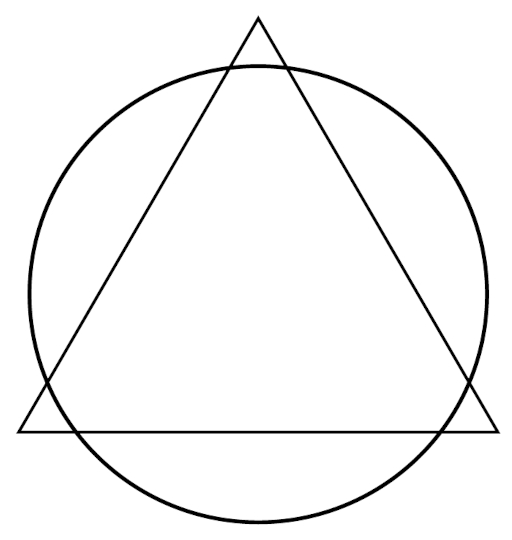
Because of its role in the search of my goal, I wanted to report these findings about the World Clock here, but Pauli's harmonizing image was his, not mine. My fitting symbol is shown in Fig. 1 and emerged by an apparent synchronicity to be explained. But before this symbol is unveiled, I would like to convey my new feeling of hope by balancing the earlier dream with the following more recent one. Dream: Everything in my visual field is dimly lit. I am standing at an observation point along a corridor which seems to encircle a large, rounded, futuristic ship along its equator. The corridor is hollowed out of the surface of the ship, and there is a security wall of half height along the outer boundary of the walkway. Sensing that I should quickly catch a glimpse of something fleeting in the heavens before me, I look up, and the magnificent sight comes into focus. It is overwhelming. Some sort of eclipse of the Sun seems so close that I could almost touch it. But the celestial body that is fleetingly in front of the Sun is not opaque. It seems that it could only be the Moon, and yet powered by the brilliance of the Sun, it has become like a giant, translucent glass ball or lens. The next glance shows apparent reflections in its surface, a view back in my direction, a view which is curved in the roundness of this celestial body. The images in the reflection are those of nature on Earth with all its stunning colors and diversity, as if everything were in its original, pristine state. The Sun's rays are still visible at the edge of this heavenly scene, but just a moment later, the Sun begins to reappear, as if re-emerging from an eclipse. Instead of feeling the glare most strongly from the Sun itself, I feel it at the far lower left of my visual field. So I look away and slowly return to wakefulness. In a spontaneous vision, I look back at the structure I was standing on. Here I see an eerily pristine white sphere, and the corridor forms a ring on the equator of the sphere. The surface of the sphere is not smooth but rather of a wonderfully uneven, finely dimpled texture, as if it consisted of stucco. Behind the sphere, as in the rest of the dream scenery, there is only a background of dim white light. There is nothing behind the white sphere which would account for the apparent reflections of fresh scenes on Earth. It was as if the Moon and the Earth had been interwoven in an inexplicable way. So by means of the eclipse, Sun and Moon+Earth appeared in union. Together with the white sphere, an astronomical syzygy had been formed. Just afterwards, I got up and walked around my neighborhood under the night sky, continuing to feel overwhelmed by what I had just witnessed. I thought then, and still do: This must be the most important dream of my life. Associations might lead to celestial scenes in the Space Odyssey film [20]. It should be noted that Kubrick and Clarke were indeed inspired by Homer's Odyssey [20] (see wiki). The original and daring odyssey was at sea, later in space and later still in the psyche. Evidently the filmmakers tapped into a collective resonance. |
| Symbolic |
|
Now, finally, to a symbol which feels right to honor and to thank Kurt Gödel. While working on a draft of this article, I was sitting at a seaside together with my wife, Brigitte Koris-Keeling. She knew roughly about the topic of the draft, so I said out of the blue: The work needs a symbol... Without hesitating for a moment, she pulled out a napkin and spontaneously drew the symbol shown in Fig. 1. I was stunned...she is musician become analyst, and yet she would soon be surprised at how fitting her drawing is. As with Pauli's Hexagram Dream, there are natural and meaningful higher-dimensional correspondences (see endnote 8) to the symbol in Fig. 1, but its simplicity is compelling. It is also remarkable how strongly this symbol resembles the Trimurti discussed in an alchemical context in [27] (p. 48). Moreover, Janis Maxwell, the Pauli specialist at the CGJIZ, once dreamed of a voice proclaiming: All you need is a circle and a triangle. I might have preferred simply to leave these extraordinary facts as they were, without supplementing them with further explanation. Nevertheless, I cannot resist writing the following discussion about the alchemical nature of the spontaneous symbol and its connection to Gödel. The Philosopher's Stone is often associated with a more complex symbol consisting of a circle inscribed in a square, which in turn is inscribed in a triangle, which is finally inscribed in a circle [22]. The symbol represents the task to "square the circle", i.e., to find a square with the same area or perimeter as a given circle, these being measures which involve the number π. Because of properties of π, which were proved as recently as in 1882, this task cannot be accomplished in a finite number of steps using only simple geometric tools [21]. Thus, it's natural to associate the alchemical work with this difficult task. Yet essentially the same symbolic content can be found in the much simpler configuration in Fig. 1. The unit circle and the triangle shown have an identical perimeter, namely 2π. Again, because of the properties of π, it is not possible to "triangle the circle", i.e., to construct a triangle with the same perimeter as a given circle in a finite number of steps using only simple geometric tools. The simple creation in Fig. 1 corresponds to a task transcending finite means, and it is meant to symbolize Gödel's creation which corresponds to a truth transcending the Ego's means. That we are subtly able to be conscious of these facts, in spite of our otherwise tremendously limited faculties, I accept gratefully as a pure gift. |
|
|
Figure 1: Geometric representation of the alchemical idea to
"triangle the circle", transcending finite geometric means, as Gödel's
creation transcends the Ego's means. |
| Endnotes |
|
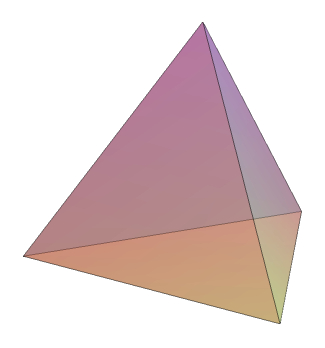
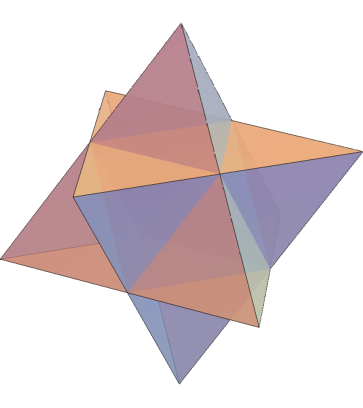
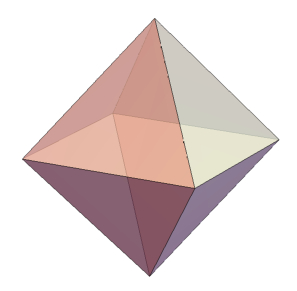
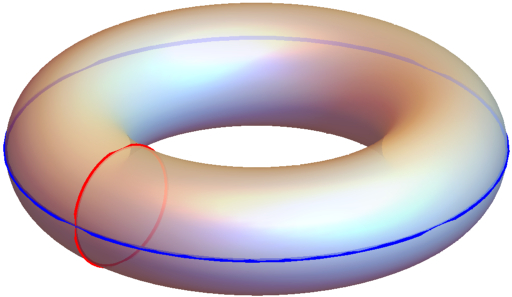
1. As Atmanspacher suggests, his tripartite symbol for the Pauli-Jung dual-aspect monism bears a remarkable resemblance to the Borromean rings, which symbolize Christian trinity and unity. It is similarly remarkable that these symbols resemble that shown in Fig. 1! 2. A tetrahedron is shown in Fig. 2a. The regular tetrahedron is a pyramid with four identical triangular faces and six identical edges. Its structure is frequently used to represent the carbon atom, the basis of organic material. The "side projection" through opposite edges appears as Pauli's hexagram. The "top projection" through a vertex and its opposite face resembles the symbol shown in Fig. 1! The tetrahedron is formed by joining two "broken" triangles, twisting in opposite directions, each resembling a double spiral. With attention to interpretations in [32], I distribute the trigram bits along the one and then the complementary double spiral to map the hexagram onto the tetrahedron. Cullinane's [6] edge-consistent arrangement of hexagrams was conceived for M.-L. von Franz's criss-cross bit distribution, but the arrangement can just as well be adapted for my spiral distribution. I use this arrangement later to identify Pauli's World Clock with the I Ching. See the supplement [19] for elaborations and illustrations of these constructions. 3. A Merkaba is shown in Fig. 2b. The Merkaba is given by two overlapping tetrahedra which interpenetrate in such a way that the tetrahedral vertices coincide with the vertices of the cube which circumscribes the Merkaba. The projection through a vertex and the opposite face of one of the two interpenetrating tetrahedra appears as Pauli's Star of David. The vertices and faces can be associated naturally with the psychic functions defined by Jung. 4. An octahedron is shown in Fig. 2c. A regular octahedron has eight equivalent triangular faces. A square lies embedded between each of its opposite vertices, and an octahedron lies embedded within the Merkaba. 5. The quoted scene: https://youtu.be/ZHb7Iho2gjw 6. Some colleagues from the CGJIZ may remember our discussion of the number of pulses in a full cycle of the World Clock. We focused on the assumed count, 323 = (23)5, where the numbers 2, 3 and 5 are found at the beginning of the Fibonacci sequence, for which the quotients of consecutive entries converge to the golden ratio. I confess that the beauty of this picture distracted me from an initial error. A careful reading of Pauli's words shows that one revolution of the golden ring corresponds to 322 small pulses, not 323. Thus, 4 revolutions of the golden ring correspond to 4 × 322 = 642 small pulses. 7. A torus is shown in Fig. 2d. This surface looks like a tire tube or like a doughnut, with circular cross-sections in both the equatorial and meridional directions. 8. A higher-dimensional correspondence to the symbol in Fig. 1 is given by a tetrahedron and a sphere, the two having one common center and the same surface area. I associate the vertices of the tetrahedron with Body, Mind, Soul and Spirit, as these are clarified in the first footnote of [16]. I associate the shared center with the Self. That neither the round nor the faceted is entirely contained, one within the other, shows me a reciprocal bond between creator and created. |
|
||||||||||||||
|
Figure 2: (a) A tetrahedron has four equivalent triangular faces.
(b) A merkaba is a union of an upright and an inverted tetrahedron.
(c) An octahedron has eight equivalent triangular faces.
(d) A torus has circular cross-sections in both the equatorial
and meridional directions. |
| References |
|
[1]
Alcaro, A., Carta, S., & Panksepp, J. (2017). The Affective Core of the
Self: A Neuro-Archetypical Perspective on the Foundations of Human (and
Animal) Subjectivity. Frontiers in Psychology 8, 1424. [2] Atmanspacher, H. & Rickles, D. (2022). Dual-Aspect Monism and the Deep Structure of Meaning, Routledge. [3] Atmanspacher, H. (2025). Dual-Aspect Monism as a Mindset, International Congress of Analytical Psychology, IAAP2025, Zurich. [4] Brouwer, L.E.J. (1911). Über Abbildung von Mannigfaltigkeiten. Mathematische Annalen 71(1), 97 - 115. Brouwer's Fixed Point Theorem on Wikipedia, The Free Encyclopedia, https://en.wikipedia.org/wiki/Brouwer_fixed-point_theorem. [5] Clarke, A.C. (1951). The Sentinel. 10 Story Fantasy 1(1), 41 - 47, Avon Periodicals Inc. [6] Cullinane, S.H. (1989 - 2006). Geometry of the I Ching, http://finitegeometry.org/sc/64/iching.html. [7] Edinger, E.F. (1999). The Psyche in Antiquity, Book One: Early Greek Philosophy, Book Two: Gnosticism and Early Christianity, Inner City Books. [8] Ezekiel. Vision of the Throne Chariot, Chapter 1, Book of Ezekiel, Old Testament. Wikipedia, The Free Encyclopedia, https://en.wikipedia.org/wiki/Ezekiel_1#Vision_of_the_throne-chariot_(1:4-28). [9] Freeman, J. (1959). BBC Face to Face interview. https://youtu.be/2AMu-G51yTY. [10] Gendlin, E.T. (1962). Experiencing and the creation of meaning: A philosophical and psychological approach to the subjective, Free Press of Glencoe. [11] Gödel, K. (1931). Über formal unentscheidbare Sätze der Principia Mathematica und verwandter Systeme I. Monatshefte für Mathematik und Physik 38(1), 173 - 198. [12] Goldwyn, S. (Producer), & Koster, H. (Director). (1947). The Bishop's Wife [Film]. RKO Radio Pictures. [13] Hoffman, D.D. (2019). The Case Against Reality, W.W. Norton & Company. [14] Hofstadter, D.R. (1979). Gödel, Escher, Bach, Basic Books. [15] Holton, G. (2003). Einstein's Third Paradise. Daedalus 132(4), 26 - 37. [16] Jacobi, J. (1942). The psychology of C.G. Jung: An introduction with illustrations, (K.W. Bash, Trans.). Routledge & Kegan Paul. [17] Jung, C.G. (1963). Memories, Dreams, Reflections, Recorded and edited by Aniela Jaffé, translated by Richard Winston and Clara Winston, Pantheon Books. [18] Jung, C.G. (1953 - 1979). The Collected Works of C.G. Jung, Vols. 1 - 20, (H. Read et al., Eds.; R.F.C. Hull, Trans.). Princeton University Press. [19] Keeling, S.L. (2026). The unabridged, fully illustrated supplement to: How free am I, really? Zenodo. https://doi.org/10.5281/zenodo.20686142. [20] Kubrick, S. (Director, Producer, Screenplay) & Clarke, A.C. (Screenplay). (1968). 2001: A Space Odyssey [Film]. Metro-Goldwyn-Mayer. Wikipedia, The Free Encyclopedia, https://en.wikipedia.org/wiki/2001:_A_Space_Odyssey. [21] Lindemann, F. (1882). On the Number π. Mathematische Annalen 20(2), 213 - 225. Wikipedia, The Free Encyclopedia, https://en.wikipedia.org/wiki/Squaring_the_circle. [22] Maier, M. (1617). Atalanta Fugiens, Emblem XXI. [23] McGilchrist, I. (2009). The Master and His Emissary: The Divided Brain and the Making of the Western World, Yale University Press. [24] Penrose, R. (1989). The Emperor's New Mind: Concerning Computers, Minds and the Laws of Physics, Oxford University Press. [25] Penrose, R. (1994). Shadows of the Mind: A Search for the Missing Science of Consciousness, Oxford University Press. [26] Solms, M. & Panksepp, J. (2012). The "Id" Knows More than the "Ego" Admits. Brain Sciences 2(2), 147 - 175. [27] Stein, M. (2025). Jung and Alchemy, Chiron. [28] Turing, A.M. (1936). On Computable Numbers, with an Application to the Entscheidungsproblem. Proceedings of the London Mathematical Society 42(1), 230 - 265. [29] van den Hooff, H. (2025). Analytical Psychology and Brain Hemisphere Research, International Congress of Analytical Psychology, IAAP2025, Zurich. [30] von Franz, M.-L. (1974). Number and Time: Reflections Leading Toward the Unification of Depth Psychology and Physics, (A. Dykes, Trans.). Northwestern University Press. [31] von Franz, M.-L. (1980). Alchemy: An Introduction to the Symbolism and the Psychology, Inner City Books. [32] Wilhelm, R. (1967). The I Ching or Book of Changes, (C.F. Baynes, Trans.; 3rd ed.). Princeton University Press. |
| Mag. Dr. Stephen Louis Keeling looks back on a career spanning decades as a natural scientist and university professor of mathematics, with positions at NASA, Vanderbilt University, and the University of Graz. Following his training in Analytical Psychology at the C.G. Jung Institute Zurich, he shifted his focus to Jungian research, concentrating on alchemy, synchronicity, and dream groups. Together with Mag.a Brigitte Koris-Keeling, he is the co-founder of Dream Analysis in Small Groups. Further biographical details and contact information are found at https://traumanalyse.at. |