pdf version
Deutsch:

Stephen Louis Keeling
September 23, 2026
| DOI: 10.5281/zenodo.22752701 |
pdf version Deutsch: |
|
Can I love someone, really? Stephen Louis Keeling September 23, 2026 |
|
Summary: This article could only have been written after the previous one in [17], which resolved the mystery of personal freedom and creativity. The subtle resolution was achieved through a lifetime of unrelenting devotion. Once resolved, that breakthrough laid bare a parallel, deeper devotion to the mystery of love and trust between two people, which had lain waiting beneath the previous dedication. This progression was necessary for me: first the One, and then the Two. I must be free to be able to love. I write here in the first person, without any academic shield, sharing my own story because this is such an intensely personal matter. What is this thing called love between me and another person? How do I know when I have experienced it genuinely? In search of answers to such questions, my perspective is that of a mathematician strongly influenced by C.G. Jung. I consider what Jung and other experts have to say about love, but ultimately I reach conclusions other than theirs, and my own indirect resolution of the mystery is deeply moving to me. Now I can feel trust and express love - with emotional clarity as well as the certainty that neither the how nor the why can ever be explained. Keywords: love, trust, Nash-equilibrium, Turing-computability, transcendence |
| A Journey Calls |
|
How free am I, really? - a question I have grappled with
throughout my life, driven by an unrelenting devotion that finally led to the
resolution presented in my article [17]. I never expected such a
transformational answer. The conclusion was that freedom is part of our
natural faculty to be creative - a faculty that can be indirectly proven to
exist, though it lies beyond a purely rational understanding. With this
epiphany in hand, the path cleared to face what lay waiting - an equally
compelling mystery: Can I love someone, really? In fact, I can already sense
the next step in a trilogy: Do I ever find belonging, really? Looking back
now, I can see that I needed to understand the One before the Two, and the Two
will bring me closer to the Many. Maybe you too have often asked, first as a young person and then even much later: What is this thing called love between me and another person? How do I know when I have experienced this love genuinely? Is it a singular truth to be discovered, or is it inherently fleeting, revealing a new quality in every new situation? Maybe your curiosity, too, has been fueled by literature, music, and film, not to mention an advertising industry that deliberately targets our most vulnerable longings. |
| Consulting the Experts |
|
To approach these questions, I want to begin with the perspectives
of recognized experts on the subject - perspectives that turn out to contrast
sharply with my own conclusions. The list cannot be exhaustive, but I consider
a spectrum from Freudian psychoanalysis to Transactional Analysis to
Behavioral Psychology, represented by Erich Fromm [7], Eric Berne
[3] and John Gottman [11]. Artists, musicians and poets may recognize they are not explicitly represented in this spectrum. Craving their indulgence, I want to trust that they will nevertheless find deep resonance in these pages. Should they lean toward viewing my conclusions as self-evident, I would recall a metaphor from my previous work in [17]. It posits that, for most people, it is self-evident - if only on statistical grounds - that intelligent life is not limited to our world alone. Yet, the actual discovery of an indirect but unmistakable signature of that intelligence leaves no room for lingering doubt. This premise expresses my motivation: to explore, to discover, and to see what we may truly know. In The Art of Loving [7], Fromm denies that love is a passive phenomenon found through lottery luck or by matchmaking calculation. Instead, he claims that love is an active practice for which one must accept existential responsibility to overcome isolation. For what I want to present, it is significant that he defines love as a deliberate act of human Will. Berne stands at the crossroads between psychoanalysis and behavioral psychology. In Games People Play [3], he abstracts human relationships into games in which players operate unconsciously from states he calls Parent, Adult or Child to satisfy unconscious wishes. According to his schema, only the Adult state can break this unconscious cycle; the resulting intimacy is what represents Berne's notion of love. Later, I place a strong focus on the meaning of games. On the staunchly empirical side of the spectrum stands Gottman, whose behaviorist approach builds upon the view that human actions result purely from positive and negative reinforcements [22]. Applying this to relationships through the concept of Behavior Exchange [11], he views a loving relationship as a stable equilibrium ensuing when a system of mutual rewards emerges passively or is constructed actively. This perspective is strongly retrospective, bringing order to events after they happen. I want to ask instead about the nature of actions as they unfold. But isn't a reward-based attitude implicit in all these approaches? Do the work; get the benefits. Isn't the mystery of love simply tucked away behind the label of Will? If the Will were such a self-evidently given module, it could be programmed into an AI android to execute the same kind of activity. Aren't these authors really just describing events in retrospect, without considering the generative miracle of the creative leap? |
| Jungian Perspective |
|
I noted earlier my need to understand the One before the Two - an
intuition implying that the pre-image of the pair can already be found within
the individual. Grappling with the mystery of freedom in [17] led me
to my own symbolic representation of Jung’s notion of inner and outer worlds
([15], footnote 1). The climactic symbol of [17] is the circle+triangle,
made through the infinite steps of the alchemical task to "triangle the
circle". While these aspects have profound meaning for me concerning the One, the maxim "as above, so below" (CW14:651, [16]) hints at counterparts beyond the isolated individual. Joining circle and triangle seems not only to symbolize the harmonious union between inner and outer worlds of the One, but also the analogous bond between the One and the Other. Yet the path here, leading up to the spontaneous symbol in Fig. 3, has unveiled how the bond in the Two is enormously more dynamic and complex than the union in the One. Nonetheless, the focus of Jung's writings seems to remain strictly within what is relevant for the individual. Even so, his clarification of what love is not, and his warnings about projecting inner ideals, are masterful. I find the crescendo in (CW7:374, [16]), which leads toward a conscious relationship with the soul image (anima:animus) and more deeply with the wise old sage (mana-personality), to be a thrilling unveiling of the Self. On the other hand, his conclusion in the marriage essay (CW17:187, [16]), that the outer relationship amounts to one person being the container and the other the contained, is soberly uninspiring, leaving no room for mystery. Jung's distant treatment of love seems to mirror familiar aspects of his own personal life, most notably the relationship triangle involving himself, his wife Emma Jung-Rauschenbach, and his patient-turned-analyst Sabina Spielrein [23]. However, there is a place in his work where I sense him coming tantalizingly close to the threshold I wish to cross in this article. It occurs in (CW13:248, [16]), during his alchemical analysis of the fairytale "The Spirit in the Bottle", from which he derives his stages of consciousness development. These stages begin with a spooky, unconscious identification between inner and outer contents. Through a progressive infusion of consciousness and the withdrawal of projections, one arrives at a fourth stage characterized by a total absence of awe toward, or projection onto, the other. Freud would likely regard this state as the ideal. What draws me more deeply into Jung's treatment, though, is his acknowledgment of a fifth level of consciousness development. Here, one becomes aware that the outer, spooky element is not merely an illusory phantom; instead, the unconscious sense of spookiness reveals itself as a manifestation of synchronicity (CW8:417, [16]). |
| Synchronicity |
|
In my article [17] I introduced synchronicity in an
everyday context, which remains applicable in the present article. I suggested
that when we say something genuinely new has been created, we mean that
it has emerged in a way that is neither random nor a necessary consequence of
precursors; yet, it is meaningful, as might be recognized through the
crystallization of a so-called felt sense [9]. Creation is
evidently synchronistic. Synchronicity is perhaps better understood more generally in the context of the Pauli-Jung Conjecture, which can be summarized as follows. It begins by accepting the Unus Mundus as the thoroughly undifferentiated, deepest Reality upon which our existence is based. Yet between us and that deep level are the archetypes which structure manifestations. We experience such events through mental and physical aspects, emerging correlated by shared meaning, but without one causing the other. Whether such events are conspicuous or not, Pauli and Jung understood them through an acausal connecting principle which they called synchronicity. The details are articulated masterfully in [2]. |
| Breakthrough |
|
I argue in [17] that synchronicity is the basis of
individual freedom in particular and creativity in general. The deciding
example is given by the mathematician Kurt Gödel and his creation, the
Gödel Theorem, which was obviously not purely random, provably not
rationally determined, and yet manifestly meaningful. This epiphany was transformative for me, establishing the provable existence of a vast reality beyond rationalism - a reality bearing indirect traces of enriching intangibles. While love may be rendered to the ranks of spookiness by Jung's fourth stage of consciousness development, I am convinced that in his fifth stage, love can be recognized as a manifestation of synchronicity. After beginning the present article, I realized that the same reasoning in [17] can be applied to a coupled, interwoven system of two people, instead of simply to a single individual. This means that the pair may create something genuinely new in the relationship, exceeding what the individuals could do separately or rationally. In particular, it is possible for them to create an entirely new and shared reality with an emergent trust, transcending both their inborn primal trust and the trust regained individually through personal experience. This shared state of synchronistic creativity and transcendent trust is what I believe we mean when we say two people love each other. This love is evidently not guaranteed for every pair, particularly when the synchronistic roots are not aligned, but the possibility of it alone is a reason to be joyful. Yet, Jung emphasizes the importance of discovering the light and the dark in apparently joyful encounters (CW7:78, [16]), and of confronting the opposites to integrate them into a synthesis (CW14:705, [16]). |
| Beacon: Alicia and John Nash |
|
To elucidate the opposites - defensive vs. vulnerable - I turn
now to yet another mathematician, John Nash [20]. In the general
public, Nash is probably best known through the depiction of his life in the
film A Beautiful Mind [13]. In the scientific community, he is
best known for his Nobel Prize-winning work in economics, where he developed a
concept in game theory now known as the Nash equilibrium
[20]. This equilibrium is a combination of strategies among competitors
guaranteeing payoffs that cannot be unilaterally improved by any single
player, assuming all other players maintain their current strategies. The rational concepts from Fromm, Berne and Gottman lead to notions of equilibrium between so-called lovers, which in each case can be seen as a corollary to the theorems proved by John Nash. This fact might lead to the impression that Nash is as far away from the mystery of love as any of the persons mentioned. Yet Nash became a living paradox. While his theories seem to be wrapped in a rational straitjacket, they emerged from his brilliant creativity - a creativity that exposed him to the collective depths and threatened his sanity. The scarcely containable explosive forces in his psyche led ultimately to an eruption of schizophrenia. Why might his life story have something essential to do with love? I see mystery in what unfolded between John and his wife Alicia, and between John and his colleagues at Princeton. It would not have been possible for Alicia to provide the entirety of what John needed in order to recover. So it's important to emphasize the role of the Princeton Sanctuary - a place of safety maintained by colleagues with commitment for John during his illness. Nevertheless, as the focus here is on the pair, let's consider the dynamic between John and Alicia. According to John's own theories, one might anticipate an equilibrium between him and his wife that would be entirely other than what actually happened. John himself might have modelled their situation with a simple game discussed in more detail below and illustrated in Figs. 1 and 2. For this, consider two players, John and Alicia, who each have the strategies: be defensive or be vulnerable. If Alicia had chosen the defensive strategy at the crucial moment, John would have remained institutionalized without burdening her with his illness. Yet there was something mysterious between the two of them that led them both to choose the vulnerable strategy. Alicia stuck with John, sensing the unexplainable gifts she shared with him. Anchored by the bond with those who loved him, John finally recovered from his illness. In my eyes, their story stands as a gentle beacon of the very love I have tried to capture here. |
| Pygmalion Myth |
|
John's life-story is not a distant piece of history for me. It's
personal. Schizophrenia was in my family too. It was very moving for me to see
the effect on John's family as depicted in the film [13]. To invest my
own psyche in this effort to understand love, I present the following dream,
which came to me while I was still struggling with the topics of the freedom
article [17]. Dream: It begins in darkness, in a deep underground chamber. I see a woman who is fiercely resourceful and yet vulnerable towards me. I later associate her with Rooney Mara, as in her leading role in the film The Girl with the Dragon Tattoo [5]. She is kneeling down to the floor, working goal-driven on four cube-shaped devices for me, which are placed on the floor at corners of a square. I approach her and say that I am very glad that she is there - perhaps returned. She says the same to me, and I feel her intensity. Now I'm above ground in sunlight, sitting at a picnic table with three women, two to my left and one across from me. The woman across from me seems very rational, and I later associate her with the physicist Sabine Hossenfelder [14]. I speak at the table, but all my words seem to come not from me, rather from a deeper place. My voice is passionate about some ideas which were precursors to those in [17]. At some point the woman across from me mentions a sense that the issues have to do with - but she struggles to pronounce the name, so I complete it for her - "Pygmalion". This sounds interesting to me, though I don't understand the connection, and I wake up. I confess that I was startled after waking up because I drew a blank on the Pygmalion myth. The matter was clarified after re-reading [6]. In the myth, Pygmalion is unable to find a real woman who matches his inner ideal. He projects this image onto an ivory statue which he sculpts. His longing to have his ideal intensifies so much by crafting and worshiping the female figure, that Venus animates the statue. In [6], Edinger refers to (CW14:705, [16]) and explains that Pygmalion is the ultimate psychological metaphor for the potential of active imagination. This myth illustrates a process in which one invests so much psychic energy that an inner, unconscious figure is animated, becoming an equal partner to effect a synthesis of inner opposites. However, Edinger warns that the confrontation must be genuine and not partial, since otherwise a fantasy is fed, and a true integration cannot take place. It occurs to me that an unyielding confrontation with the mysteries at hand has the intended effect. In the dream, the women at the picnic table represent a progression of maturity, leading up to the highly rational Ms. Hossenfelder. The polarity that occurs to me is that Mara would be more likely to tell me about Pygmalion, while Hossenfelder would be more likely to tell me about a geometric construction. Edinger's warning suggests that these two poles must be thoroughly integrated. When I broadly consider what Mara is doing in the dream, I realize the geometry is almost literally a representation of Jung's model of the Self with four quaternia around a square, as illustrated in (CW9ii:410, [16]). In place of the quaternia are the cube-shaped devices, and I imagine each as a stabilized cube according to Buckminster Fuller [8] - i.e., two interpenetrating tetrahedra forming a merkaba, as explained in [17] (supplement). It is as if she and I are already working together to resolve the mysteries I have named in this article. But this is only the broad perspective. When I step into that dark chamber through active imagination, I feel the intense polarity in the Girl with the Dragon Tattoo. In the film [5], she opens up to the journalist and helps him; in the end, he betrays her, and she discards a thoughtful gift meant for him. In my dream, she is mainly defensive, but she wants to be vulnerable with me, and to help me. I too want to welcome her. Neither the Buddhist symbolism of Māra [4] nor the Nigredo symbolism of the dragon (CW12:404, [16]) frighten me. On the contrary, I am eagerly vulnerable. It seems to me now that the dream images of these two women, Hossenfelder and Mara, were already helping me inwardly to unravel those mysteries that have driven me throughout my life: freedom, love and belonging. |
| High-Stakes Game |
|
In this section I want to invite you into John Nash's world of
games. Here we will discover how and why love is not computable. Let's suppose
that John and Alicia are in a situation where they must decide whether they
choose to be defensive (D) or vulnerable (V) with each other.
Let's denote
these strategies by DA and VA for Alicia
and DJ and VJ for
John. Let's suppose they rate, on a scale of 1 to 10, how they feel when these
four possible combinations of strategies are played. Call these ratings
rewards, as they are listed in Figs. 1a and 2a for the
two examples, which I have freely invented purely for illustrative
purposes. Specifically, the rewards for the pure combinations are given as
pairs of numbers (A,J), where A is Alicia's reward and J is John's
reward. For instance, when both play defensively (DA and DJ) in
Fig. 1a, the pair (8,6) means Alicia's reward is 8 and John's
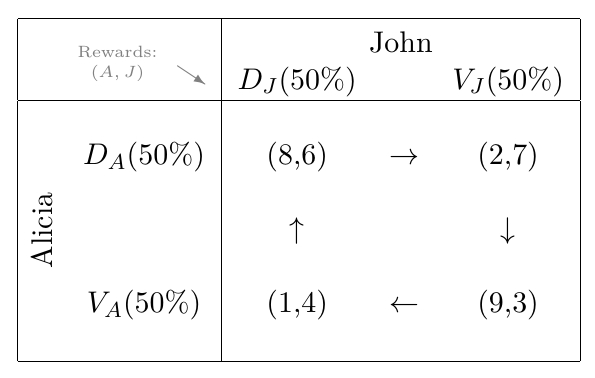
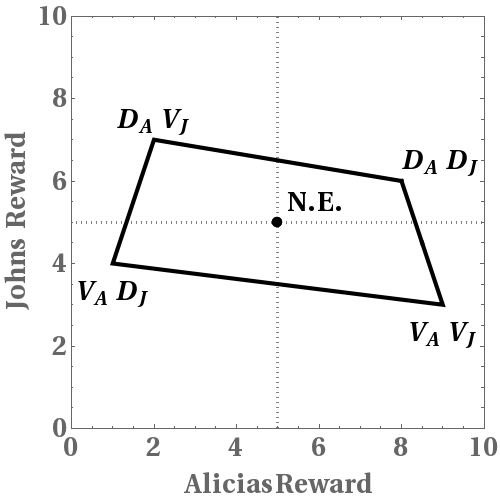
reward is 6. Consider the arrows among the paired rewards in Fig. 1a. In the DJ-column, John is playing defensive. When Alicia plays vulnerable (VA), her reward is 1, but when she plays defensive (DA), her reward goes up to 8. The upward arrow means she has an incentive to move from vulnerable to defensive as long as John remains defensive. Similarly, in the VA-row, Alicia is playing vulnerable. When John plays vulnerable (VJ), his reward is 3, but when he plays defensive (DJ), his reward goes up to 4. The leftward arrow means he has an incentive to move from vulnerable to defensive as long as Alicia remains vulnerable. The other two arrows among the paired rewards are explained similarly. This means that the reward pairs run in a clockwise circuit, without there being a corner where they would both be satisfied not to change strategy further. These corners are also seen in Fig. 1b: (8,6) are the coordinates of DA DJ, (2,7) are the coordinates of DA VJ, and so on, around the four-sided form in the graph. We could interpret their respective psychologies by considering what drives the jump from one corner to the next, but the continuing cycle is evidently unsatisfying. |
|
||||||
|
Figure 1: (a) The pairs of numbers (A,J) are the reward values for Alicia
(A) and John (J) with pure strategies, either defensive or vulnerable.
For instance, when both play defensive (DA and DJ), then the
corresponding pair (8,6) means Alicia has reward 8 while John has reward
6. The percentages 50% refer to the specific mixed strategy in which they
are defensive or vulnerable 50% of the time. (b) The rewards for the pure
strategies give the coordinates of the corners of the four-sided form.
Playing the pure strategies with varying chances gives all the mixed
strategies, and the expected rewards for these correspond to the inside of
the outlined region. The Nash equilibrium is marked in the middle at (5,5)
with N.E.; see endnote 1 for the details. |
|
||||||
|
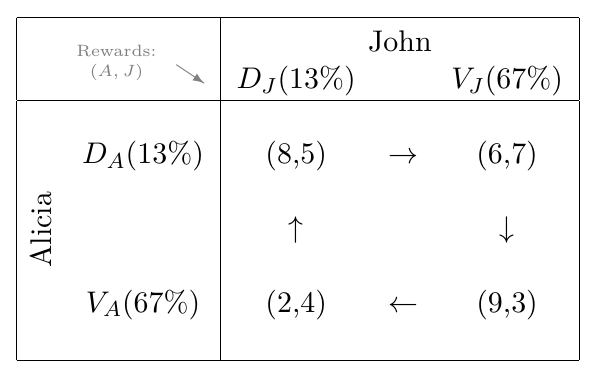
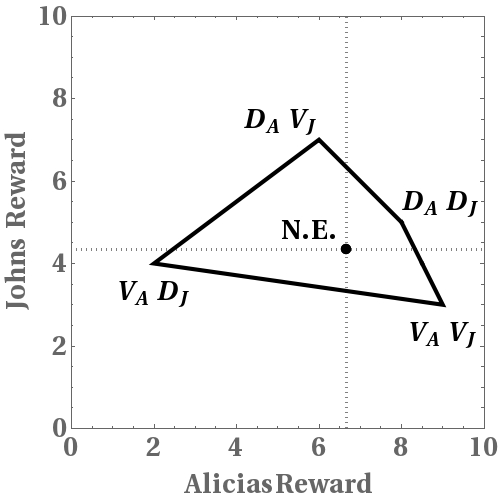
Figure 2: The format here is the same as in Fig. 1. However, note
that in (a) some reward values are a bit different than in
Fig. 1a. Also, the chances of the strategies are no longer fixed
at 50%; instead each player is defensive with a chance of 13% and
vulnerable with a chance of 67%. As a result, in (b) the outlined region is
more skewed than in Fig. 1b. The Nash equilibrium is marked in at
(6.7,4.3) with N.E.; see endnote 2 for the details. |
|
However, the dissatisfaction may be alleviated by considering
so-called mixed strategies. Their strategies are mixed when they say they will
play one pure strategy or the other with a certain chance. The rewards
corresponding to all such mixed strategies lie within the four-sided form in
Fig. 1b. Note in Fig. 1a that each strategy, D or V,
appears together with "50%". This means that they will play their
available strategies with a 50-50 chance. This special combination of mixed
strategies corresponds in Fig. 1 to the Nash equilibrium, which is
marked in Fig. 1b with "N.E." Here the expected rewards are at
(5,5) in the graph, i.e., 5 reward points for each player; see endnote 1 for
the details of the calculation. At this point, both Alicia and John have no
incentive to change their strategy while the other holds their position. That they have no incentive to change their strategies seems like a brighter situation than that with circulation through pure strategies. Yet, at the Nash equilibrium, they are still at a kind of stalemate, in which they are each being vulnerable only 50% of the time. But notice the big changes that occur in Fig. 2 when a few reward values are altered. With these new reward values, there is still a circular pattern among the pure strategies; however, the Nash equilibrium is given by mixed strategies in which they are each vulnerable with a 67% chance! The Nash equilibrium is marked again with "N.E." in Fig. 2b. Here the expected rewards are at (6.7,4.3) in the graph - i.e., 6.7 reward points for Alicia, more than the 4.3 reward points for John; see endnote 2 for the details of the calculation. |
| Resolution |
|
The two examples in Figs. 1 and 2 suggest
that, with further attempts, Alicia and John might be able to calculate an
ever more satisfying result, something ever closer to mutual vulnerability and
equitably high expected rewards. However, in everyday life, neither player is
aware of the other player's information. To settle on her own reward values
and mixed strategy, Alicia would have to anticipate the reward values and the
mixed strategy of John. If John is doing the same, Alicia's estimate of John
is based on John's estimate of Alicia, and vice versa. Note that the reward
values are also a moving target, because the rewards of one generally depend
on the rewards of the other. To know whether this cycle of computation would
ever halt seems deeply problematic. It is. The fundamental Halting Problem is to find a computer program that could determine whether another arbitrary program, given a specific input, would eventually halt or else continue computing indefinitely. In [24], Alan Turing showed this is not possible. If such a decider program were to exist, a second adversary program could be constructed to do the exact opposite of the prediction. By feeding this new program its own code as input, it would halt if predicted to continue indefinitely, and it would continue indefinitely if predicted to halt, creating an irreconcilable paradox. According to Turing, the solution to the Halting Problem is non-computable. Building on this foundation, and upon related economic examples in [1], suppose the following about Alicia and John. Assume that Alicia had a decider program that could always determine the desired equilibrium by calculating her mixed strategy, based upon her reward values and upon an estimation of John's reward values and his mixed strategy. If the determination of the equilibrium were computable, then in principle John could use an adversary program that anticipates the output from the decider program and produces an output contrary to it, one that foils the arrival at the desired equilibrium. The cycles and the sensitivity to changes in values seen in Figs. 1 and 2 illustrate how easy it would be to sabotage the intent of the other for one's own gain. Thus, the proposed decider program cannot exist. The desired equilibrium may indeed exist, but the problem to determine it with mutually incomplete information is non-computable. Nevertheless, we can know something about the iterative estimations with mutually incomplete information. It turns out that the sequence of iterates is a system, call it S, that satisfies the conditions of Gödel's Theorem. Each estimation step acts as a logical deduction within the system. Recall from [17] that Gödel demonstrated the existence of a statement A in S that is fundamentally true but can never be proven using the rules of S. In our estimations for the defensive-vulnerable game, that true but unprovable statement A is that the equilibrium is not attainable within the system S. We can verify from the outside that an ideal equilibrium exists, but we can never establish or reach its truth from the inside by merely continuing the calculations. Yet the vulnerable-vulnerable state does manifest. It seems apparent in the true-life story of Alicia and John. The threshold of the definition of love is palpable here. The non-computability just demonstrated shows that a sudden transition to mutual vulnerability cannot be a calculated consequence of precursors. The desired state cannot be anticipated rationally in detail, but the truth of its existence can be known. Once the state is reached it is undeniably meaningful and self-evidently not random. By taking the leap to this synchronistic state, two people create something genuinely new - a shared trust that transcends what otherwise might ever have been. |
| Metamorphosis |
|
In (CW8:982, [16]) Jung recounts an experience with a
patient whose analysis was making no progress because her conscious attitude
was so extremely rational. One day she presented a detailed dream about a
golden scarab, and suddenly Jung noticed the actual, unexpected appearance of
a living scarab beetle at his window. The unexplainable event broke through
her rationalism, and the analysis could then proceed to a positive
conclusion. For me, this is one of the most compelling examples of
synchronicity. In this section, I want to recount a similar experience of my
own. Dream: There are three scenes. In the first scene, I am standing on the deck of a large wooden ship in a well-lit swimming hall. Looking down into crystal clear water, I see the stone sculpted by Jung at Bollingen. In the second scene I am at a quiet cocktail party. I recognize a man, the Lama, who was once my Buddhist teacher. He has become ill and stumbles away to the left. I am holding a glass of Campari, in which a fibrous mass forms as if a precipitate from a chemical reaction. I suspect that the substance has poisoned the Lama. In the third scene I am back in the well-lit swimming hall, as if the second scene had been a dream within a dream, and I have awakened from it. I enter the hall by foot from the other side of the hall as before, I then walk into and through the water with water up to the waistline. I am careful because the stone must still be under the water. Then comes the shock of realizing I'm walking on the outside surface of the bottom of the ship! The ship must have been lifted and turned over. The greatest tension comes when I see Jung's stone standing on top of the underside of the ship, as if Jung himself had placed the ship that way. I wake up immediately. I associate the light with something trying to reach consciousness. The water is not deep, but the darkness of the middle scene takes me deeper into the unconscious. There begins an alchemical shift from the old king, the Lama, to the new, Jung. The wooden ship is a refuge in the arena of consciousness. Jung must shock me to deliver his message: Discard the ship, the mantle of the Ego; take heed of what is hidden underneath the overturned ship, in the middle dream. So what else is it in the dream-within-a-dream that I am supposed to notice? I recognize that there are no women in any of the scenes. Yet one woman I know is implicitly present, and I associate her with the Campari. It took some time for me to recognize that the chemical reaction in the Campari corresponds to the Gray-Scott reaction-diffusion system [19]. The system involves two diffusing species, say U and V, which react to produce more V. Then V decays to a third species P. The reaction is called autocatalysis because V is involved in its own production. The system can produce emergent spatial patterns, which may easily be associated with a metamorphosis. The precipitate appearing in the Campari was a typical pattern that forms during the Gray-Scott reaction. After I recognized the chemical reaction in the dream, I went back to read about it. Suddenly, the autocatalysis equation leapt off the page at me: 1U+2V→ 3V. In a flash the coefficients 1, 2, 3 triggered a memory: I had met the woman implicitly present in the dream on the date MM.DD.YY = 01.12.23. The lightning of the
synchronicity struck
me. It was she who catalyzed a transformation in the dream. At the time I was
too foggy to anticipate what lay ahead, but two years later she and I would be
married. The two of us are the sole reason I am able to write this article. |
| Symbolic |
|
I recalled earlier that the climactic symbol in [17] is the
circle+triangle,
made through the infinite steps of the alchemical task to "triangle the
circle". This symbol was unveiled in [17] as a spontaneous product
of intuition from my wife, Brigitte Koris-Keeling, about that work. Just as
Gödel's creation transcends the Ego's means, the symbol transcends finite
means - i.e., it is non-constructible: It cannot be made with a finite number
of steps using only classic geometric tools. On the other hand, I note here
that rendering this symbol digitally is computable [21], albeit with
an infinite number of steps. Now I want to unveil a symbol for this work that revealed itself to me spontaneously just before my wife and I were married. It is the dynamic symbol shown in Fig. 3. The golden and silver spirals begin at separate locations, but they both wind toward an implicit circle in the middle. For paths originating outside it, this circle acts as an attractor - a so-called limit cycle; see endnote 3. |

|
|
Figure 3: Twin spirals moving toward an attracting circle in the
middle. The two spirals wind ever closer to what they can never actually
reach directly, but their joint motion establishes the presence of the
goal. |
|
I find the beauty of the symbol in Fig. 3 very
compelling, and only now do I recognize that, as a symbol for the Two, it is
vastly more complex than the previous symbol for the One. Indeed, the twin
spirals satisfy a far more radical and strict quality of true
non-computability. To see this, note that from any point outside the circle there ensues a spiral that approaches the attracting limit cycle. The gold and silver spirals are two such examples with starting points on opposite sides of the circle. If another starting point for a third spiral is chosen ever closer to the circle, it becomes ever more difficult to decide whether it evolves closer to the gold or to the silver spiral. In fact, according to [12], to accomplish this task for an arbitrary point chosen near the limit cycle is demonstrably non-computable! Although the twin spirals in Fig. 3 are beautiful, I find that they mirror the relentless cyclic patterns found in the interactive games of Figs. 1 and 2. I observed earlier, guided ironically by mathematicians - Gödel, Nash and Turing - that a transcendent reality hovers just beyond the endless loops: The travelers have a destination, but it cannot be reached by algorithmic steps. The central epiphany in this work is to recognize genuine love between two people as their synchronistic creation of an entirely new and shared reality, imbued with a trust transcending any they may have previously experienced. I would not have been able to recognize here that the Two have the capacity to create, had I not discovered in [17] that the One has the capacity to create. Yet there is another epiphany in this work that I take personally into my daily life. To express this, I first want to thank you for patiently undertaking the journey with me through games and strategies and equilibria and limit cycles. But this journey had a purpose and an important conclusion. For me it is this: Try as it may, the Ego can never understand love. Creation in general and Love in particular need the fullness of whole persons. To know this truth personally comes at a late hour in my lifetime, after decades of struggling, stumbling, but always getting back up again. Did this happen as a result of, or inspite of, tremendous effort? Both, neither ... rather an in-between, I guess. |
| Endnotes |
|
1. The Nash equilibrium for the example of Fig. 1 is
determined explicitly as follows. Suppose Alicia will play the vulnerable
strategy VA with an as yet unknown probability p. Since she will play
some strategy, the two probabilities must add to 1; so, the probability
that she will play the strategy DA is 1-p. Similarly, suppose John will
play the strategies VJ and DJ with probabilities q and 1-q,
respectively. Then the expected reward for Alicia by playing DA is given by
the sum of her rewards in that row, weighted by John's probabilities of play:
8(1-q)+2q. In the same way, her expected reward for playing VA is given
by the weighted sum of her rewards in that row: 1(1-q)+9q. At the Nash
equilibrium, Alicia must have no preference regarding her choice of pure
strategy, so these two expected rewards for her must be equal:
8(1-q)+2q=1(1-q)+9q or q=0.5, and the expected reward for Alicia is
5. Analogously, the expected rewards for John by playing DJ or VJ are
given by the weighted column sums, 6(1-p)+4p and 7(1-p)+3p. At the Nash
equilibrium, John must also have no preference regarding his choice of pure
strategy, so these must be equal: 6(1-p)+4p=7(1-p)+3p or p=0.5, and the
expected reward for John is 5. 2. The Nash equilibrium for the example of Fig. 2 is determined explicitly as follows. As in endnote 1, suppose Alicia plays the strategies VA and DA with probabilities p and 1-p, and suppose John plays the strategies VJ and DJ with probabilities q and 1-q. Alicia's expected reward for DA is 8(1-q)+6q and 2(1-q)+9q for VA. Setting these to be equal under the condition of equal preference at the Nash equilibrium gives 8(1-q)+6q=2(1-q)+9q or q=2/3, and Alicia's expected reward is 20/3. John's expected reward for DJ is 5(1-p)+4p and 7(1-p)+3p for VJ. Setting these to be equal gives 5(1-p)+4p=7(1-p)+3p or p=2/3, and John's expected reward is 13/3. 3. The dynamical system underlying these trajectories is given by the system of differential equations: x′ = (1 − r2)x − y, y′ = (1 − r2)y + x, r2 = x2 + y2, where the limit cycle is given by r = 1. |
| References |
|
[1]
Anderlini, L. (1990). Some notes on Church's thesis and the theory of
games. Theory and Decision, 29(1), 19-52. [2] Atmanspacher, H. and Rickles, D. (2022). Dual-Aspect Monism and the Deep Structure of Meaning, Routledge. [3] Berne, E. (1964). Games People Play: The Psychology of Human Relationships. Grove Press. [4] Bodhi, Bhikkhu (Trans.) (2000). The connected discourses of the Buddha: A translation of the Samyutta Nikaya, Wisdom Publications. (Original work compiled c. 1st century BCE). [5] Chaffin, C., Rudin, S., Søndberg, O. and Stærmose, S. (Producers), Fincher, D. (Director). (2011). The Girl with the Dragon Tattoo [Film]. Columbia Pictures; Metro-Goldwyn-Mayer; Yellow Bird. [6] Edinger, E.F. (1995). The Mysterium Lectures: A Journey Through C.G. Jung's Mysterium Coniunctionis. Inner City Books. [7] Fromm, E. (1956). The Art of Loving. Harper & Row. [8] Fuller, R.B. Synergetics. Wikipedia, The Free Encyclopedia, https://en.wikipedia.org/wiki/Synergetics_(Fuller). [9] Gendlin, E.T. (1962). Experiencing and the creation of meaning: A philosophical and psychological approach to the subjective, Free Press of Glencoe. [10] Gödel, K. (1931). Über formal unentscheidbare Sätze der Principia Mathematica und verwandter Systeme I, Monatshefte für Mathematik und Physik, 38(1), 173-198. [11] Gottman, J., Notarius, C., Markman, H., Bank, S. and Yoppi, B. (1976). Behavior exchange theory and marital decision making. Journal of Personality and Social Psychology, 34(1), 14-23. [12] Graça, D.S., Zhong, N. and Buescu, J. (2015). An Analytic System with a Computable Hyperbolic Sink Whose Basin of Attraction is Non-Computable. Theory of Computing Systems, 57(2), 478-520. [13] Grazer, B. (Producer), Howard, R. (Director). (2001). A Beautiful Mind [Film]. Universal Pictures; DreamWorks Pictures. [14] Hossenfelder, S. (2022). Existential Physics: A Scientist's Guide to Life's Biggest Questions. Viking. [15] Jacobi, J. (1942). The psychology of C.G. Jung: An introduction with illustrations, (K.W. Bash, Trans.). Routledge & Kegan Paul. [16] Jung, C.G. (1953-1979). The Collected Works of C.G. Jung, Vols. 1-20, (H. Read et al., Eds.; R.F.C. Hull, Trans.). Princeton University Press. [17] Keeling, S.L. (2026). How free am I, really? Psychological and mathematical perspectives on creativity and freedom (with illustrative supplement and German translations). Zenodo. https://doi.org/10.5281/zenodo.20686142. [18] Lindemann, F. (1882). On the Number π, Mathematische Annalen 20(2), 213-225. Wikipedia, The Free Encyclopedia, https://en.wikipedia.org/wiki/Squaring_the_circle. [19] Munafo, R.P. (1996-2024). Reaction-Diffusion by the Gray-Scott Model: Pearson's Parametrization. https://www.mrob.com/pub/comp/xmorphia/index.html. [20] Nash, J.F. Wikipedia, The Free Encyclopedia, https://en.wikipedia.org/wiki/John_Forbes_Nash_Jr.. [21] Penrose, R. (1989). The Emperor's New Mind: Concerning Computers, Minds and the Laws of Physics, Oxford University Press. [22] Skinner, B.F. (1953). Science and Human Behavior. Macmillan. [23] Thomas, J. (Producer), Cronenberg, D. (Director). (2011). A Dangerous Method [Film]. Recorded Picture Company; Prospero Pictures. [24] Turing, A.M. (1936). On Computable Numbers, with an Application to the Entscheidungsproblem, Proceedings of the London Mathematical Society 42(1), 230-265. |
| Mag. Dr. Stephen Louis Keeling looks back on a career spanning decades as a natural scientist and university professor of mathematics, with positions at NASA, Vanderbilt University, and the University of Graz. Following his training in Analytical Psychology at the C.G. Jung Institute Zurich, he shifted his focus to Jungian research, concentrating on alchemy, synchronicity, and dream groups. Together with Mag.a Brigitte Koris-Keeling, he is the co-founder of Dream Analysis in Small Groups. Further biographical details and contact information are found at https://traumanalyse.at. |