pdf Version
Deutsch:

a lecture from Mag.a Brigitte Sükar
as part of the exhibition and the commemoration of Bruno Ertler
on the occasion of the 90th anniversary of his death
|
pdf Version Deutsch: |
|
Lilith-Eve-Venus (Aphrodite) a lecture from Mag.a Brigitte Sükar |
|
in the Styrian State Library on October 12, 2017 as part of the exhibition and the commemoration of Bruno Ertler on the occasion of the 90th anniversary of his death |
|
Bruno Ertler and the women: Lilith and Eve, great female characters,
especially interesting because of the division into good and evil, into
wholesome and destructive, as Ertler experienced and makes palpable for us in
his poems. Bruno Ertler, also as a searcher for the connecting element, namely
love through the symbol of Aphrodite/Roman Venus. Ertler in connection with
mythologies of the female. All this in 20 to 30 minutes! Ladies and gentlemen,
I can tell you that this has been the biggest challenge! Because connected
with the female side of the soul, the anima, both in the woman and in the man,
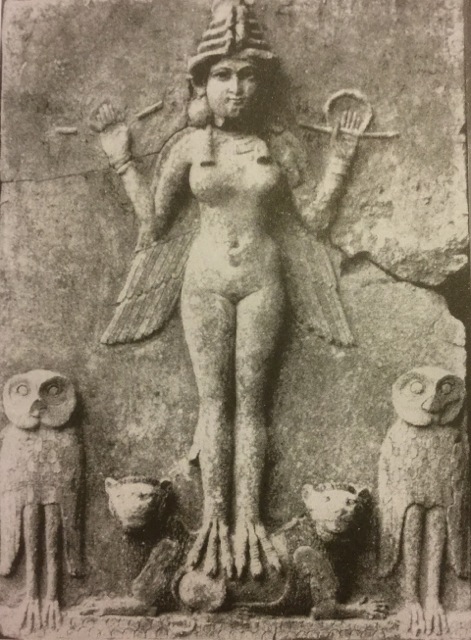
we encounter a completely different dimension of time and space! A few words in advance about C.G. Jung: Together with Freud and Adler, he was one of the three great psychoanalysts of his time. Perhaps most importantly on today's topic, Jung expanded Freud's concept of drives by exploring the collective unconscious. Together we are all connected there, in the most different ways, and that's where we're going now, into the realm of mythology. Lilith, Sumerian goddess, the missing female side of God? Or Adam's first wife? Locked away for thousands of years, punished, demonized, largely gone from people's consciousness and yet always highly effective in us, there is a loud knock on our door again. She wants to be heard and seen. I have been invited to speak as a woman, as a Jungian analyst, and as a Lilith researcher. I had to smile at that expression: I was equally honored and disturbed. I immediately felt the enormous ambivalence that hides behind this great, female archetype. Is it even possible to research Lilith? An archetype whose most prominent trait is evasion? Can we, do we want to, or should we shape, organize, pin down such a fundamental feature of the female psyche? Demonized by world religions as the darkness of women and declared by some psychologists, to this day, as the shadow of women! What is it which is so scary? Danger, the forbidden is in the air, which of course makes it doubly interesting for us humans. Something invigorates, attracts, makes you creative and curious. Lilith, the "wild woman". What is meant is not "gone wild" or "out of control", but rather the original meaning, namely that of a natural way of life, in which the word "wild" is a metaphor for the power from which female creatures can intuitively draw nourishment and exist unharmed. So is Lilith described by the analyst Clarissa Pinkola Estes in her book The Wolf Woman. Perhaps the wild woman is the prototype of the primeval woman par excellence, because her nature always remains the same, regardless of times, politics, cultures and religions. At every turn in my therapeutic practice of depth psychology, I encounter this mostly unknown and untamed feminine aspect of the soul - in contrast to that associated with Eve. With Lilith there is something that wants to live, but it is unseen, that is, pushed into the shadows, and so it causes damage if it cannot be recognized and integrated. For me, dealing with Lilith is therefore more of a psychological reality than a religion. Today, Lilith seems to be socially acceptable. She is no longer seen only as a fury who murders men and children, but as lively, freedom-loving and also rebellious against the existing patriarchy. Indeed, she is even portrayed as a lover who has been cruelly betrayed in her desire to be respected for who she is and just as she is. Viewed independently of images of God, Lilith, Eve and Aphrodite are contents of the great female archetype. Archetypes, on the other hand, are closely linked to people's imagery, fantasies and projections. And projections, as seen in Lilith and Eve, are thoroughgoing! While Eve has firmly established herself as Adam's wife, his rib, and temptress to evil in most minds, the projection surfaces around the partly unknown Lilith flourish unbroken today. So Lilith is back in the limelight. I interpret it as a quality of consciousness, "as in the lime-light". Women with this awareness can focus on what is important to them. Writers, musicians and painters also devote themselves to her, but above all, she finds her place in the women's movement for the first time. Feminists, for example, declare Lilith to be the first emancipated woman ever. If we want to take a closer look at Lilith, Eve and Aphrodite from the psychological point of view of Jung's theory of archetypes, we first need to know a few basic concepts. For example, what are archetypes and how do they work in the human soul? They are the preconfigurations, also basic structures of the soul, and thus form the contents of the so-called collective unconscious. In contrast to the personal unconscious, which is closely related to our biography, we are dealing with a deeper layer of the unconscious that no longer stems from personal experiences and acquisitions, but is connected to generally valid content, i.e., they are innate. Since we cannot grasp archetypes with definitions, we enter areas such as myths, religions, fairy tales, dreams and visions. In myth, as in religion and in fairy tales, the life of the soul opens up through the formation of so-called concentrations of meaning, which constitute essential focal points or junctions in their action. Today's topic on Ertler's poems is about exactly such focal points and nodes in the projections of men through images of women. In this case, they provide the mythological motif that has captured the attention of each generation anew over long periods of time, perhaps even since primeval times. How does it happen that there are projection surfaces like Lilith and Eve which persist over long periods of time? In his writings "Psychology and Alchemy", Jung leaves no doubt that religions also emerge from the nature of the soul. In this way, religions can also be seen as a further development of mythology. However, I see Lilith and Eve as Christian concentrations of meaning, already trapped in a constraining patriarchal archetype. While Aphrodite/Venus, as a concentration of meaning in Greek/Roman mythology, seems to occupy a special position as a metaphor for love. Whether this is more of a natural product of the human soul, i.e., closer to God, I don't know. We see particularly in symbols that the most essential basic structure of the soul is its ambiguity. We can interpret it either way. At the symbolic level, let's look at the image of the Sumerian goddess Lilith: |
|
|
• Lilith appears here naked. That could appear threatening, but it could
also be a symbol of unadulterated purity, because whoever is naked has
nothing to hide after all. • What do you think the face shows? happiness? serenity? Or is it enigmatic? even demonic? • We might see wings as an aspect of flightiness, which does not inspire much confidence, but maybe it's also a symbol of creativity. We then feel inspired in the truest sense of the word. • Owls have always been messengers not only of evil and death, but also of wisdom and knowledge. • The bird's claws show us their danger. She shows her claws, her animalistic, untamed side, her impulsiveness, which by no means has to be synonymous with devilishness, but rather also an expression of passion and assertiveness. There is no question that Lilith is also dangerous, but not only! In depth psychological practice, dealing with the unconscious is about taking back as many projections as possible, and thus it's about a process of differentiation. And that's exactly what we need when it comes to Lilith and Eve! And to keep the matter from being simple, archetypal patterns from the collective unconscious on the one hand and instinctive drives on the other, i.e., everything learned and experienced, are so closely connected in humans that it is difficult to tell when something is connected to personal complex material and when it is no longer so. It is therefore incredibly difficult not to immediately take a stand for one or the other. In any case, in Ertler's poems about Eve and Lilith, the division into good and evil is still very clear. The entire Lilith complex, which of course also harbors a very long shadow, is conceptually very difficult to explain or describe, but the female psyche nevertheless knows its truth. It's not only a different way of feeling, but also a different way of thinking, a matriarchal consciousness, a female logos. It is the otherness, and many a woman knows what powerlessness it leaves behind to be smiled at and devalued in that otherness. It is a vibration, present under all attempts at verbalization, and it is devalued simply by wanting, or trying, to reach a point in which it is put more concretely. The elusory, the incomprehensible, frightens and encounters resistance! Not only in men, also in women. It is also a defense that moves men, for example, to say things that are hostile to women, attacks, women's jokes of countless kinds, which women more or less endure in a never-ending loop. It was probably men who brought the cruel Lilith myth into the world. An (arche)typical case of shadow projection, says the Jungian analyst Vera Zingsem: "Man fights in a woman what he dislikes about himself - and makes her pay for it." Fundamentally, Ms. Zingsem points out that, regarding the creation of the first human couple and thus also the love between man and woman, our culture has two skeletons in the closet: Lilith, the autonomous woman who leaves Adam because he wants to force her into the inferior position and - I was also amazed to learn - the first Eve, who was cast out by Adam because he felt an indomitable distaste for this more adaptable version. The third attempt in the mythological tales, the second Eve, the so-called rib, something that accordingly emerges from Adam himself, could therefore only be his daughter, says Zingsem. It's worth thinking about, because of course this wouldn't be love at eye level, an equal partnership, but rather love without confrontations and arguments - a point of view that could lead to the assumption that the man is probably not up to a real man-woman relationship. Lilith, the self-determined thinker, demonizes. Eve is a multiple loser because she is inquisitive and eager to talk to the snake, thus bringing evil into the world and at the same time losing her status as the "mother of all living". Is female thinking not allowed in order that it not get to the bottom of the patriarchal image of God? And what is woman's revenge in the patriarchal understanding? The analyst Erich Neumann, in his attempt to combine feminist insights with the psychology of C.G. Jung, writes in the book Amor und Psyche: "When the masculine is dominant, namely in consciousness, the anima, i.e., the feminine, is pushed into the unconscious. In this way the male loses his soul and with it unconsciously himself to the woman. This loss makes the soul infantile, it makes the man...dependent on the feminine in his feelings." And I mean: such a feeling is naturally scary! However, the most frightening area in the Lilith metaphor today is still sexuality, the natural urge. This becomes apparent when we consider that women have always known about the weaknesses of men and some have consciously used men's sex drive to achieve their goals. The fear of men, but also of women among themselves, of this cold, calculating aspect, is quite justified! Bruno Ertler knew intuitively what terrible fear Lilith can trigger, but also what sad truth lies behind it. We will then listen to his poem Event. However, collectively to block out something threatening, or generally to declare it evil, has a psychological effect on the human soul like a boomerang. It comes back twice through the back door because it is seen only from one side! As we know, being unconscious can cause a great deal of damage. For C.G. Jung it is the original sin, for Logos it is quintessential evil. In social life, i.e., viewed from the outside, we women are probably well on the way to becoming the better men. Freely based on the motto of the song from My Fair Lady: "anything you can do, I can do better! I can do anything better than you!" A logical, radically emotional consequence of injuries and humiliations. Are we still trapped in a patriarchal consciousness today? Do we try to think even more masculine and thereby lose our otherness? Can we women still afford to be muses and be taken seriously at the same time? Do we really have to be the better men, mutilated in our differences under an overwhelming rationalism? One of the main focal points of the general subject matter of women seems to be the image of God itself. The theologian and analyst Sepp Maderegger writes in his book Demons that God is something so sacred to believers that any connection with evil seems impossible. However, culture and religious history show that all superhuman beings worshiped by peoples and cultures are related. This is what first gave Jung the idea of tracing the totality of beings transcending man back to a single archetype, namely the archetype of the image of God. He says the difference in religious beliefs, the relationship between good and evil spirits, are cultural reflections of this archetype. And further in his book Answer to Job we can read: "...that is probably the greatest thing about Job that he...does not get lost in the unity of God, but clearly sees that God finds himself in contradiction with himself...Insight existed next to lack of insight, like goodness next to cruelty and like creativity next to the will to destroy...". According to this theory, we encounter here the contradiction of an exclusively male God, but it would be the same with a female God image, an inconsistency in themselves in the origin of both. The lack of a female image of God makes it clear why the fear of the contradiction of the female is still much greater than that of the male. The experience of so-called evil is the greatest challenge facing humanity and forces everyone to take a stand. Psychologically, there are two fundamentally different models for evil. First, we can regard it as belonging to ourselves and take responsibility for it; in this way, we would be working with our own shadow. Alternatively, we can load it onto others: the evil fellow human beings, the hostile people, the dark aspects of one or the other, the devil, the demon, male or female, the woman! One of the most common manifestations of evil, according to Sepp Maderegger, is not only disguise, but deception, namely in the guise of God, because endowed with such an appearance, it can violate human nature unhindered. Has this happened to women? Lilith was not even unconsciously repressed, but consciously banished and demonized. And what is demonized long enough will one day appear as a male or female demon. It has been psychologically proven that complexes can also grow when they are enriched with a high-energy, archetypal background. The development of the witch craze of the Middle Ages had the same basis: There was the splitting of the image of women, on the one hand, into the adored in the knight ideal and the saint in the veneration of Mary, and on the other hand, into the woman as an exclusively sexual being with simultaneous devaluation of sexuality. As the analyst Jean Shinoda Bolen puts it: "When women's sensuality and sexuality are demeaned - as is the case in Judeo-Christian and Muslim cultures or in other patriarchal societies - the woman, Aphrodite, the beloved, is embodied as... seductress, or considered a whore." Aphrodite, symbol of love, a whore? A look back at Greek mythology shows this goddess to be both autonomous and capable of relating. So she has both: Lilith's aspirations for autonomy and Eve's ability to relate. In general, this leap back into Greek mythology shows that it is full to the brim with goddesses who, as representatives of a wide variety of female characters in their archetypal images and stories, are available for better recognition of the female soul. Now that Lilith is coming into our lives, what does that mean for the responsibility of the female Logos? Can that which has been suppressed and driven out of people's consciousness for so long still be saved, called back to full life? Analytical psychology inspires hope because it is about becoming whole, about individuation, i.e., about integration and, above all, about humanizing the most diverse parts of the being. This affects us women, but also and especially men, because it is clear that the pain-point of women who have lived in the shadows for thousands of years is incomparably greater than that of men. In every archetype there is light and dark, good and evil. In one as in the other it is about becoming aware of the danger and the striving for power; and together with the personal complex material, it is always about the integration of the shadow, both individually and collectively. To succeed, we need love, Aphrodite, because what use is her autonomy to Lilith if she is cold, unable to love? - when she takes what she wants, when she wants it, how she wants it and from whom she wants it, a pioneering anarchist, along with her rebellious male counterpart, Samael? In Bruno Ertler's poem Window Promenade it is noticeable what force of attraction is hidden behind the Lilith aspect and yet also missing in that aspect. As we listen to this poem, pay special attention to the last line. And Eve? What's the use of being nice, kind, and able to relate if she can't develop her autonomy? To automatically see Eve as loving, idealized by the longing for the security, warmth and protection of a mother, is a trap that Ertler also falls into in his poems. We hear this in Eve. So we need Aphrodite, that supreme alchemical goddess of beauty, creative woman and lover. Psychology also speaks of an Aphrodite consciousness or floating consciousness. Where there is love, there is openness to change. And this usually is a powerful, and often painful, process! We know that love finds us and grabs us when we are ripe for real evolution. Aphrodite represents new life, she strives for intensity in relationships and values creative processes. For me, creativity is synonymous with liveliness and is therefore the most precious thing for all of us. We are "in flow" when we are fed by our very own creative stream, but we stand still when we are cut off from our primal instincts by people or society, says Carola Pinkola Estes. From a psychological point of view, every loss of flowing energy represents a mental/emotional crisis. In Bruno Ertler's poem Difficult Days we feel this standstill. Despite his serious illness, he was mostly connected to this original, creative power. Ladies and gentlemen, I'll come to the end. We humans always have a longing for wild originality, men as well as women. Women, however, have been taught shame, and so over millennia we have learned to more or less hide our feelings. At first glance, at least in western circles, we seem to be allowed to do everything. In the so-called "reality behind the scenes", however, things are different. Can there ever be a human Lilith? Perhaps, just as with Samael, Adam or Eve, it remains dependent on being touched by the miracle of love! Whether this gift can then be accepted, or whether power, the thirst for recognition or for the satisfaction of other untended needs take the lead again, always remains exciting and open. In Lilith, there is however the light, the revolutionary, the always alive aspect of this prototype of woman, and these I see as indispensable to life. Brigitte Sükar, Wien, am 10.Oktober 2017 © Brigitte Sükar Event Red and hot, demanding and tearing, you burn. Glowing, the bottom of your gaping depths beckons, and what life rejoices in you, what threatens to die in you, cheering up and sinking. Surrender and forget to be. Everything, everything wreathes wringing hands out of you. Sincerity, deep, deadly, God-demanding truth spreads your arms, stretches the chest, spreads his eyes wide. Unmeasured greed for your red waves, shuddering dread of your aloofness, grabs me and pulls me to you, and I met God, the stormy enemy of lies. Window Promenade Almost all the houses are still sleeping in the old lane. On their flourishes and gables hangs the grey, wet morning mist in spiteful indolent mass. I know, Lilith, that it is folly to stand in front of your door in such a joyless hour and to peer in love at a curtained window, like in stupid boyhood days - which one never forgets. I would walk away in shame today when the curtain moved up there behind the blind, milk opal discs; because you shouldn't find me, when I hold silent communion with my real one and I am far from everything that is clever, thoughtful and right. Did you dream Lilith? Or did you wake up contemplatively? Or was my friend, the beautiful one, with you tonight! And you kissed often - laughed at me You see: now I suddenly know that you don't love me at all and surrender to the other with the mocking brow, because he does not lift you up into holy heavens, like me, and pray not blissfully to all that is pure in you and will never dedicate his first and last to you, like I did. And you can never forgive me for that. Eve Saints! Wonderful! Dream of my early years, risen to reality consecrated with the breath of the earth. Eve! In your eyes, encompassing looks, shines the delight of blooming life, its fruits quiet majesty and the strong knowledge of all its suffering. Expanding hearts, Striders full of gifts, Blessed ones at rest. Blessed is the beloved of God who met you. Heavy Days are hard days. The sky freezes grey and it freezes your heart. Days like tired snails, days when you encounter only pale, starving children and hostile people, are hard days. You're pounding on locked doors and nobody is - no one who opens for you. |