pdf Version
Deutsch:

It moves, expands, and shrinks.
It transforms, gives birth, begets, dies, is reborn.
It seeks, does not seek, finds, loses, connects,
loves, waits, hurries, comes, and goes."
|
pdf Version Deutsch: |
|
On the Archetype of Music |
|
"A tone lives like YOU, like ME, like SHE, like IT. It moves, expands, and shrinks. It transforms, gives birth, begets, dies, is reborn. It seeks, does not seek, finds, loses, connects, loves, waits, hurries, comes, and goes." |
| K.H. Stockhausen 1 |
|
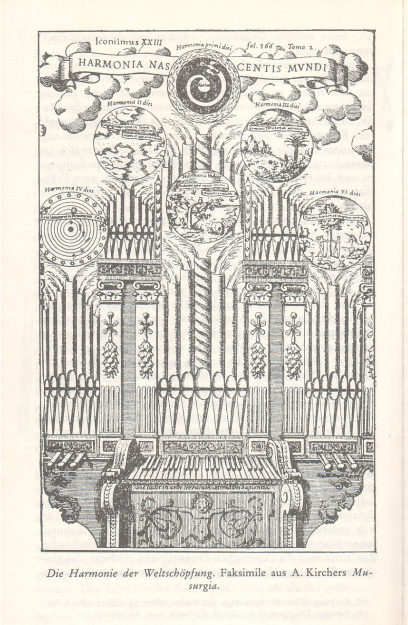
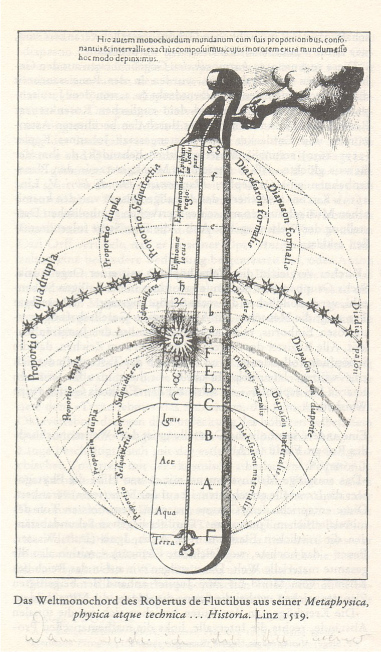
Music reaches our soul in a profoundly comprehensive way, and its deep impact results from a dynamic and constructive interplay of opposing forces. For many, it is understood solely as the language of emotion. In its holistic aspect, however, it is equally connected to thought, intuition, and perception. It unites introversion and extroversion, the individual and the collective, the masculine and the feminine, the conscious and the unconscious in its universal expressiveness. As the language of feeling, we access the nonverbal and emotional depths of the psyche. As the language of logic and thought, we rediscover within the psyche the roots of ordered primal structures that constantly reform themselves. Music, as the language of intuition, animates our imagination with the entire spectrum of dormant possibilities. Music turns outward in expansive, Dionysian rapture as readily as it turns inward in contemplative, Apollonian fashion. It invites us to dialogues spanning diverse fields of knowledge. For example, we can approach music from theoretical, analytical, natural, and humanistic perspectives, and engage with it in a meaningful way. Beyond this, however, music always speaks for itself; its vibration needs no words, and its immediate experience, its response, always reaches us nonverbally. From a musicological perspective, music encompasses the broad fields of acoustics, tone physiology, tone psychology, music theory, music pedagogy, music aesthetics, music history, ethnomusicology, and music therapy. Within this framework, music theory, as the study of musical elements, focuses primarily on rhythm, melody, meter, and harmony. 2 Jung rarely commented on music; however, we know that he placed great value on the rediscovery of the esoteric symbols of our Western culture and thus on raising awareness of Western-influenced images and archetypes. As a pioneer of East-West encounters that enabled Western culture to gain deeper insights, he nevertheless wanted to point out the danger of succumbing to the allure of the Far East and thereby losing one's own foundation for life. We can apply the same principle to collective, but also individual, musical development and experience. After a flood of exotic and magical rhythms and sounds from Asia and Africa and a veritable "psychedelic" 3 musical frenzy, induced and amplified by drugs, a shift back to one's own roots—to ancient Greece, early Christianity, and the Middle Ages—has been taking place among musicians and composers in the recent past. The music of composer Gerhard Schedl is also based on his own cultural past. Similar to analytical psychology, we also draw on the mythological and cosmological origins of music. "Thus, we consider the universe a harmonic cosmos, ordered according to measure, number, and weight, and music, which is based on the primordial numbers of the world order as powers, is the sound of this universe and of the human soul. Cosmologically, we refer to it as 'musica mundana' 4 The significance of music in antiquity was closely linked to mythical premonitions of the harmony of the spheres. Music was then considered part of the world plan, the inner workings of the world, even the world soul, the anima mundi itself. A beautiful example of harmonic symbolism is, for instance, Plato's famous description of the world soul as a musical scale." Music historian Gerhard Nestler explains: "This music was inaudible; only its symbol was audible. The symbol, however, consisted of tones or noises that humankind selected from the abundance of what the cosmos provided. Music arose from the polar tensions between the audible and the inaudible." 5 Since the time of Pythagoras, the concept of the harmony of the spheres, as a symbol of a cosmic world order, has been a recurring theme in the history of esoteric musical thought. Pythagoras' monochord experiments already contained the fundamental laws of acoustics, the relationships between intervals, and even the structure of the overtone series. Even then, acoustic proportions had been discovered that are inherent in both nature and the nature of human hearing. We are thus influenced not only by music, but by all vibrations beyond it—also in and through nature. Such vibrations, which can be measured with great physical precision, are known to us as "harmonics". They are subject to an integer order that is assigned to each individual tone. At least without training, we cannot hear them, but they nevertheless resonate within the tones and thus also within us. Only a tone with the entire spectrum of its overtones is called a sound. In myth, the world originated from sound and is also held together by sound. In connection with overtones, the term "inner octaves" is also used today. The composer, musicologist, and psychologist P.M. Hamel writes: "Very often it is only a tone, or a note, that is sustained for a very long time and rises and falls only slightly, but in this single note, 'inner octaves' and melodies are constantly taking place; 'inner octaves' that are inaudible to the ears but are felt by the emotional center."... "Objective music is based solely on such inner octaves. And it can produce not only certain psychological results but also certain physical results. There can be music that freezes water. There can be music that would kill a person instantly. The biblical legend of the destruction of Jericho by music (it was the trumpets at that time) is such a legend of objective music. And it can not only destroy but also build up and heal, as we know from the legend of Orpheus." 6 When I mentioned "musica mundana," as a kind of spiritual, musical archetype, "musica humana" must not be omitted. Its particular power lies in balancing the forces of opposites, especially the contrast between soul and body. 7 Both timbre and intervals exert a powerful influence on the human psyche. Rudolf Steiner already interpreted intervals, associating the subjective—destiny—with the experience of a third, the discovery of the higher self with the experience of an octave, and imagination with the experience of a fifth. 8 Based on scientific studies of hearing, it is now established that the physiology of the ear does indeed favor intervals formed from simple proportions, thus proving the Pythagoreans right in their assertion that the same laws should exist in nature, in music, and in humankind. 9 Knowledge of interval divisions on a string, in those days the monochord, served as a link between nature and soul. Today, it can be demonstrated that there is a connection between tones and numbers. Intervals are psychologically perceptible, and their numerical ratios correspond to specific feelings. 10 The octave, fifth, and fourth are available as "pure" intervals. These can also be augmented or diminished. So-called pure intervals are characterized by a simple numerical ratio: octave = 1:2; fifth = 2:3; fourth = 3:4. The numerical ratios of the intervals refer to the frequencies of vibration of the individual notes, each note being produced by air vibration. All other intervals, such as the second, third, sixth, and seventh, are available to us in major or minor forms, but manifest themselves in significantly more complex numerical ratios. Musica humana also allows the memory to flow back to the origin of this work, to the musician Gerhard Schedl. In two exemplary audio examples, we are particularly connected to the third, which Steiner described as fateful. Incidentally, according to his son Johannes, Schedl was a numerologist, and it is suspected that the underlying numerical symbolism of some of his works contains deliberately hidden information. However, investigating this is a matter for another work. On a human level, it is readily apparent that music brought something balancing and healing to the tension-filled inner struggles of his soul. In my psychological analysis, however, I also spoke of a calamity, because Schedl needed music almost as a daily addiction. The healing effect of music in his life is beyond doubt, yet it is and remains only an archetype. For an entire lifetime, it can never replace a human and communicative "you". Last but not least, "musica instrumentalis" emerges and reveals itself in its earthy, organic aspect as we bring it to life through our instruments. Here, music presents itself through humanity, with all its strengths and weaknesses. As a musician, I can say that there is probably nothing more beautiful than bringing the multifaceted nature of music to life on an instrument through oneself. All aspects of musical activity are closely interconnected, overlapping and only together do they constitute the whole of music. Our word "music," incidentally, comes from the Greek "musike" and, in all European countries, evokes the divine origin of the ancient deities, the Muses. The Muses, initially the triad of goddesses in matriarchal societies, were later considered the nine daughters of Zeus and their mother Mnemosyne. 11 Brigitte Sükar, 2008 © Brigitte Sükar |
|
|
Endnoten: 1. Geistige Einstimmungstexte, aus den sieben Tagen, Universal Edition, Wien 1968. 2. H. Streich: Musik und Psyche, S. 4 ff. 3. "Psychedelic", a new word coined from Greek; means: "that which expands consciousness". 4. H. Streich: Musik und Psyche, S. 6. 5. P.M. Hamel: Durch Musik zum Selbst, S. 105. 6. P.M. Hamel: Durch Musik zum Selbst, S. 122. 7. H. Streich: Musik und Psyche, S. 6. 8. P.M. Hamel: Durch Musik zum Selbst, S. 109. 9. P.M. Hamel / R. Haase: Über das disponierte Gehör, S. 111. 10. P.M. Hamel: Durch Musik zum Selbst, S. 111. 11. T. Timmermann: Die Musen der Musik, S. 8. |